


NOTICE
87 AKI fuel or lower can cause the engine to
malfunction or become damaged. There is a
risk of property damage. Do not refuel with
87 AKI fuel or lower.
NOTICE
Incorrect fuels can damage the fuel system
and the engine. There is a risk of property
damage. Do not use fuels with a higher etha-
nol content than recommended. Do not refuel
with fuels containing methanol, e.g. M5 to
M100.
Recommended gas quality
91 AKI.
M Performance
model:
93 AKI.
Minimum fuel grade
87 AKI.
Using fuel with
this minimum AKI rating may
result in driving issues and strange sounds.
Knocking noises may occur, especially when
starting the engine at high temperatures. This
has no effect on engine service life.
Engine oil
Principle
The engine oil consumption and engine oil
properties depend on the driving style and op-
erating
conditions.
Therefore, regularly check the engine oil level
after refueling by taking a detailed measure-
ment.
The engine oil
consumption may increase in
the following situations, for example:
▷
Using a sporty driving style.
▷
Break-in of the engine.
▷
Idle operation of the engine.
▷
With use of engine oil types that are not
recommended.
Different Check Control messages appear on
the control display depending on the engine oil
level and engine oil
properties.
The vehicle manufacturer recommends having
engine oil changed by an authorized service
center or another qualified service center or
repair shop. The suitable viscosity grade is in-
dicated on a sign in the engine compartment.
Safety information
NOTICE
An engine oil level that is too low causes
engine damage. There is a risk of property
damage. Immediately add engine oil.
NOTICE
Too much engine oil can damage the engine
or the catalytic converter. There is a risk of
property damage. Do not add too much en-
gine oil. If there is excess engine oil, have
the engine oil level corrected by an author-
ized service center or another qualified serv-
ice center or repair shop.
NOTICE
Engine oil that is not changed in timely fash-
ion can cause increased engine wear and
thus engine damage. There is a risk of dam-
age to property. It is recommended that you
do not exceed the service intervals indicated
in the vehicle.
Operating fluids
Mobility
373
Online Edition
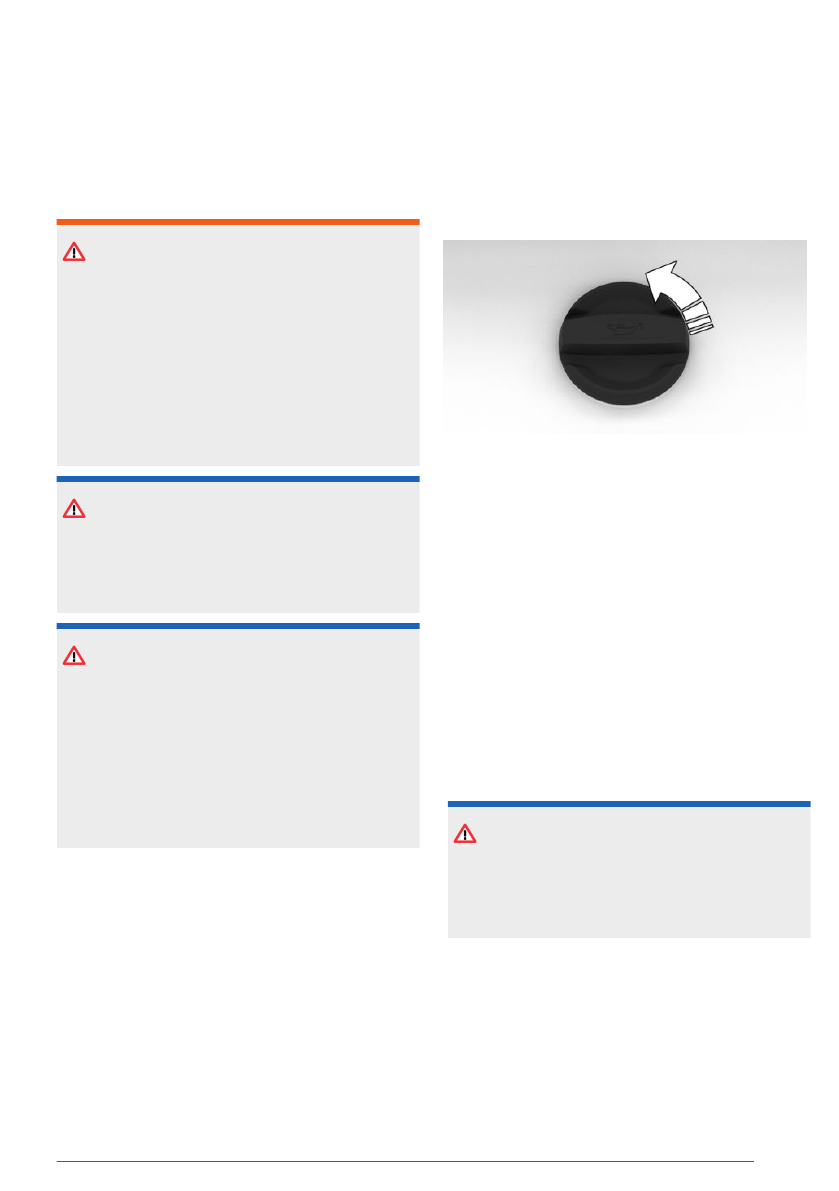
Safely park the vehicle and turn off drive-ready
state before adding engine
oil.
Take care not to add too much engine oil.
Safety information
WARNING
Operating fluids, e.g., oil, grease, coolant,
fuel, may contain harmful ingredients. There
is a risk of injury and danger to life. Follow
the instructions on the containers. Do not al-
low operating fluids to come into contact with
your clothing, skin, or eyes. Do not fill operat-
ing fluids into different bottles. Store operat-
ing fluids out of reach of children.
NOTICE
An engine oil level that is too low causes
engine damage. There is a risk of property
damage. Immediately add engine oil.
NOTICE
Too much engine oil can damage the engine
or the catalytic converter. There is a risk of
property damage. Do not add too much en-
gine oil. If there is excess engine oil, have
the engine oil level corrected by an author-
ized service center or another qualified serv-
ice center or repair shop.
Overview
The oil filler neck is located in the engine com-
partment.
Additional
information:
For an overview, refer to page
Adding engine oil
To top up the engine oil, proceed as follows:
1.
Opening the hood.
2.
Turn the lock in the engine compartment
counterclockwise.
3.
Add engine oil.
4.
Close the cap in the engine compartment.
Additional
information:
Opening the hood, refer to page
.
Engine oil types to add
General information
The engine oil grade is critical for the service
life of the
engine.
Only add with the types of engine oil which are
listed.
Safety information
NOTICE
Oil additives can damage the engine. There
is a risk of property damage. Do not use oil
additives.
Operating fluids
Mobility
375
Online Edition

NOTICE
Too much water reduces the coolant's frost
protection and corrosion protection. There is
a risk of property damage. Use a 50:50 mix-
ing ratio of water to coolant additive.
Coolant level
General information
Depending on the drive variant, there are up to
two coolant reservoirs in the engine compart-
ment. Check coolant levels on a regular basis
and refill as
necessary.
The coolant reservoir may be overfilled with
coolant when the vehicle is delivered from the
factory or following maintenance measures.
The specified coolant level is achieved with
longer operating
periods.
The nominal coolant level is indicated by the
maximum mark in the filler neck of the coolant
reservoir.
Additional
information:
For an overview, refer to page
Checking the coolant level
To check the coolant level, proceed as follows.
1.
Allow the engine to cool down.
2.
Turn off the climate control system.
3.
Opening the hood.
4.
Turn the coolant reservoir cap slightly
counterclockwise until the excess pressure
dissipates.
5.
Open the coolant reservoir cap.
6.
The coolant level is correct when it is just
below the max. level mark on
the filler neck.
This can be found on the filler neck or on
the outside of transparent coolant tanks.
7.
Close the coolant reservoir cap.
Additional information:
Climate control, refer to page
Opening the hood, refer to page
.
Adding coolant
To refill the coolant, proceed as follows:
1.
Allow the engine to cool down.
2.
Turn off the climate control system.
3.
Opening the hood.
4.
Turn the coolant reservoir cap slightly
counterclockwise until the excess pressure
dissipates.
5.
Open the coolant reservoir cap.
6.
If necessary, slowly add coolant up to the
specified fill level. Be careful not to spill
coolant.
7.
Close the coolant reservoir cap.
Additional
information:
Climate control, refer to page
Opening the hood, refer to page
.
Disposal
Comply with the relevant environmen-
tal protection regulations when dispos-
ing of coolant and coolant additives.
Washer fluid
Principle
Washer fluid is used to clean the windshields
and sensors. All spray nozzles are supplied
from one tank.
Use a
mixture of tap water and windshield
washer concentrate. If desired, a windshield
washer concentrate containing antifreeze can
be used.
The
recommended minimum fill quantity is
0.5 US gal/2 liters.
Operating fluids
Mobility
377
Online Edition


