


Cargo area
Vehicle features and options
This chapter describes model-specific equip-
ment, systems, and functions that are currently
available, or may become available in the fu-
ture, even if they are not
present in the vehicle.
Additional information:
Vehicle equipment, refer to page
.
Loading
Principle
When loading the vehicle, items and cargo
must be stowed and secured properly. Do not
exceed the permissible weights and loads.
Safety information
WARNING
High gross vehicle weight can overheat the
tires, damage them internally and cause
a sudden tire pressure loss. Driving char-
acteristics may be negatively impacted, re-
ducing directional stability, lengthening the
braking distances and changing the steering
response. There is a risk of accident, injury,
and property damage. Note the permissible
load-carrying capacity of the tires, and do not
exceed the gross vehicle weight.
WARNING
When driving, loose items or devices con-
nected to the vehicle with a cable, i.e., mobile
phones, may be thrown around the vehicle,
e.g., in the event of an accident or when brak-
ing or performing evasive maneuvers. There
is a risk of injury and risk of property damage.
Secure loose objects or devices that are con-
nected to the vehicle via a cable.
WARNING
Improperly stowed objects can slip and be
thrown into the car's interior, for instance in
the event of an accident, braking or an eva-
sive maneuver. Vehicle occupants can be hit
and injured. There is a risk of injury and risk
of property damage. Stow and secure objects
and cargo properly.
NOTICE
Fluids in the cargo area can cause damage.
There is a risk of property damage. Make
sure that no fluids leak in the cargo area.
Steps for Determining Correct Load
Limit
1.
Locate the statement “The combined
weight of occupants and cargo should
never exceed XXX kg or XXX lbs.” on your
vehicle’s placard.
2.
Determine the combined weight of the
driver and passengers that will be riding in
your vehicle.
3.
Subtract the combined weight of the driver
and passengers from XXX kg or XXX lbs.
4.
The resulting figure equals the available
amount of cargo and luggage load ca-
pacity. For example, if the “XXX” amount
equals 1400 lbs. and there will be five
150 lb passengers in your vehicle, the
amount of available cargo and luggage
load capacity is 650 lbs. (1400–750 (5 x
150) = 650 lbs.)
Cargo area
Controls
305
Online Edition
Safety information
WARNING
Improper use of the multifunction hooks can
lead to a risk of objects flying about, e.g., dur-
ing braking and evasive maneuvers. There is
a risk of injury and risk of property damage.
Only hang lightweight objects from the multi-
function hooks. Heavy luggage in the cargo
area must be properly secured.
Overview
Depending on vehicle equipment, multifunction
hooks are provided on the left and right side of
the cargo area.
Net
Depending on vehicle equipment, there is a net
on the left side of the cargo
area.
Smaller items can be stored behind the net. To
transport larger objects, slide the net down.
Storage compartment on
the right side
There is a storage compartment on the right
side of the cargo area.
Cargo area floor
Principle
To stow cargo, a storage compartment is pro-
vided under the cargo area floor. The cargo
area floor can be opened and removed as nec-
essary.
Safety information
WARNING
Improper use of the cargo area floor can lead
to a risk of objects flying about during braking
and evasive maneuvers, for example. There
is a risk of injury and risk of property damage.
▷ Do not use the cargo area floor to sepa-
rate the cargo area and vehicle interior
in the sense of a luggage net.
▷ Only use the cargo area floor in the
folded-up position when the rear seat
backrests are folded up and locked.
▷ Fold down the cargo area floor before
driving off.
▷ Always secure cargo against slipping,
using straps, belts and lashing eyes, for
instance.
NOTICE
The storage space under the cargo area floor
is only suitable for soft objects. Hard objects
may result in damage to the vehicle electrical
system in the event of an accident. There is
a risk of property damage. Only stow soft ob-
jects under the cargo area floor.
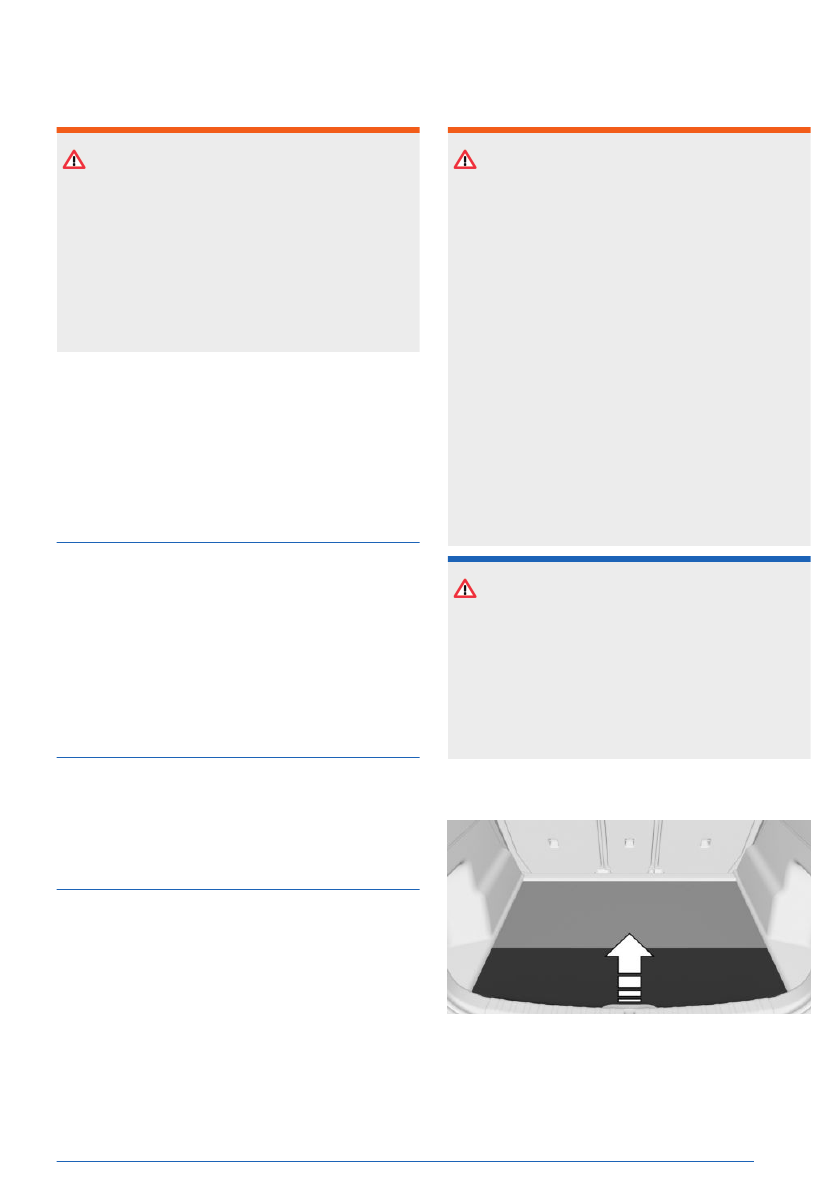
Opening the storage compartment
To open the storage compartment, grasp the
rear edge of the cargo area floor and fold it
forward.
Cargo area
Controls
307
Online Edition
General information
The rear seat backrest is divided at a ratio of
40–20–40. The side rear seat backrests and
the center section can be folded down sepa-
rately.
The rear seat
backrests can be folded down
from the rear.
Safety information
WARNING
Vehicle parts can be damaged or body parts
jammed when folding down the rear seat
backrest. There is a risk of injury or risk of
property damage. Make sure that the area of
movement of the rear seat backrest including
head restraint is clear when folding down.
WARNING
If a rear seat backrest is not locked, unse-
cured cargo can be thrown about the car’s
interior; for instance, in the event of an acci-
dent, braking or an evasive maneuver. There
is a risk of injury. Make sure that the rear seat
backrest is locked after folding it back.
WARNING
The stability of the child restraint system is
limited or compromised with incorrect seat
setting or improper installation of the child
seat. There is a risk of injury and danger to
life. Make sure that the child restraint system
fits securely against the backrest. If possible,
adjust the backrest tilt for all affected back-
rests and correctly adjust the seats. Make
sure that seats and backrests are securely
engaged or locked. If possible and necessary,
adjust the height of the head restraints or
remove them.
Cargo position
Principle
The rear seat backrests can be moved into
an upright loading position individually. An ad-
justment in several tilt stages is possible as
needed.
Adjusting
To adjust the loading position of the rear seat
backrests, proceed as follows:
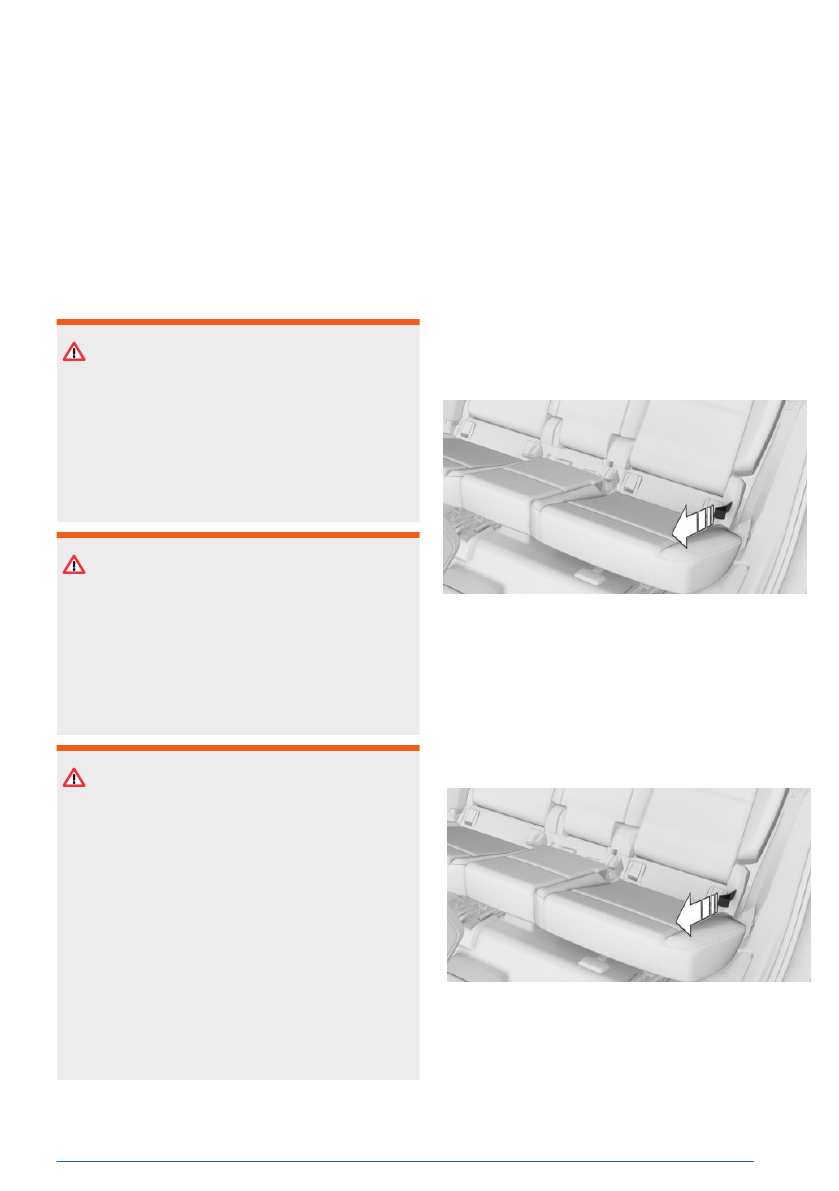
1.
Pull the loop on the side of the seat.
2.
Adjust the loading position of the rear seat
backrest as necessary.
3.
Engage the rear seat backrest.
Folding down the rear seat backrest
To fold in the rear seat backrests, proceed as
follows:
Pull the loop on the side of the seat and fold
the rear seat backrest forward.
Cargo area
Controls
309
Online Edition

Cargo area
Controls
311
Online Edition


