

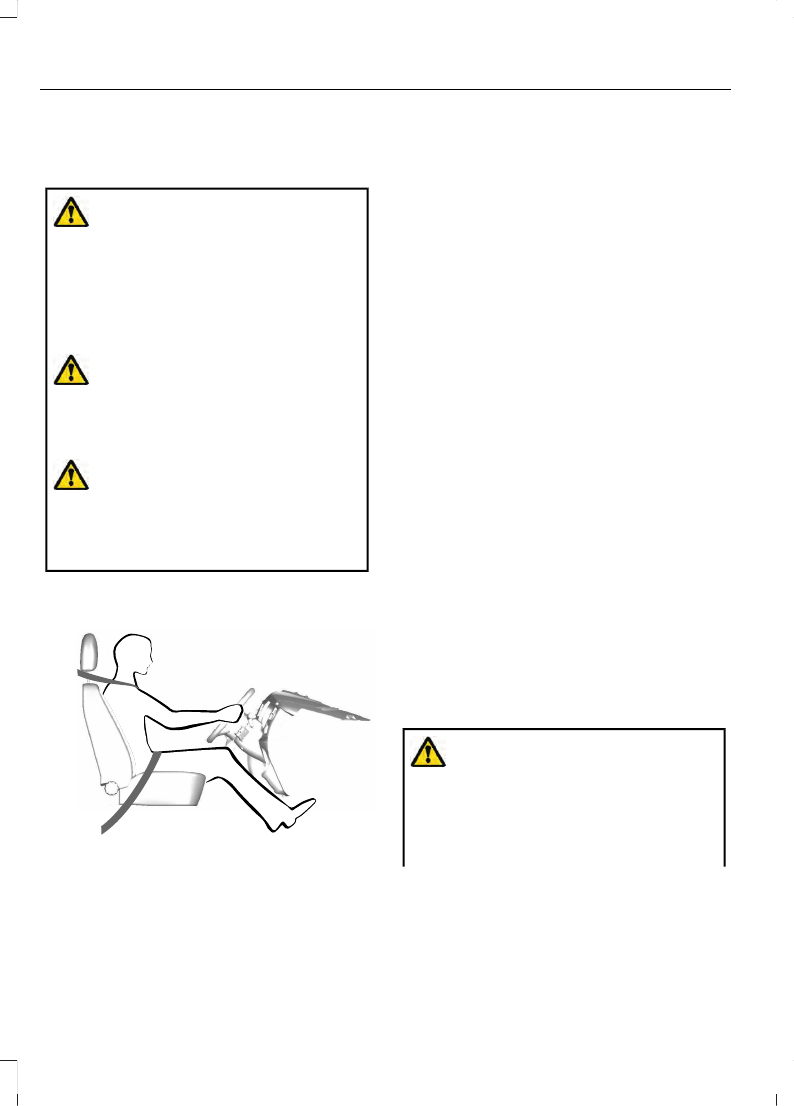
SITTING IN THE CORRECT
POSITION
WARNING:
Sitting improperly, out
of position or with the seatback reclined
too far can take weight off the seat
cushion and affect the decision of the
passenger sensing system, resulting in
serious injury or death in the event of a
crash. Always sit upright against your
seat back, with your feet on the floor.
WARNING:
Do not recline the seat
backrest too far as this can cause the
occupant to slide under the seatbelt,
resulting in personal injury in the event
of a crash.
WARNING:
Do not place objects
higher than the top of the seat backrest.
Failure to follow this instruction could
result in personal injury or death in the
event of a sudden stop or crash.
E68595
When you use them properly, the seat,
head restraint, seatbelt and airbags will
provide optimum protection in the event
of a crash.
We recommend that you follow these
guidelines:
•
Sit in an upright position with the base
of your spine as far back as possible.
•
Do not recline the seat backrest so that
your torso is more than 30 degrees
from the upright position.
•
Adjust the head restraint so that the
top of it is level with the top of your
head and as far forward as possible.
Make sure that you remain
comfortable.
•
Keep sufficient distance between
yourself and the steering wheel. We
recommend a minimum of 10 in
(25 cm) between your breastbone and
the airbag cover.
•
Hold the steering wheel with your arms
slightly bent.
•
Bend your legs slightly so that you can
press the pedals fully.
•
Position the shoulder strap of the
seatbelt over the center of your
shoulder and position the lap strap
tightly across your hips.
Make sure that your driving position is
comfortable and that you can maintain full
control of your vehicle.
HEAD RESTRAINTS
WARNING:
Fully adjust the head
restraint before you sit in or operate your
vehicle. This will help minimize the risk
of neck injury in the event of a crash. Do
not adjust the head restraint when your
vehicle is moving.
124
Seats
WARNING:
The head restraint is a
safety device. Whenever possible it
should be installed and properly
adjusted when the seat is occupied.
Failure to adjust the head restraint
properly could reduce its effectiveness
during certain impacts.
Note:
Adjust the seat backrest to an upright
driving position before adjusting the head
restraint. Adjust the head restraint so that
the top of it is level with the top of your head
and as far forward as possible. Make sure
that you remain comfortable. If you are
extremely tall, adjust the head restraint to
its highest position.
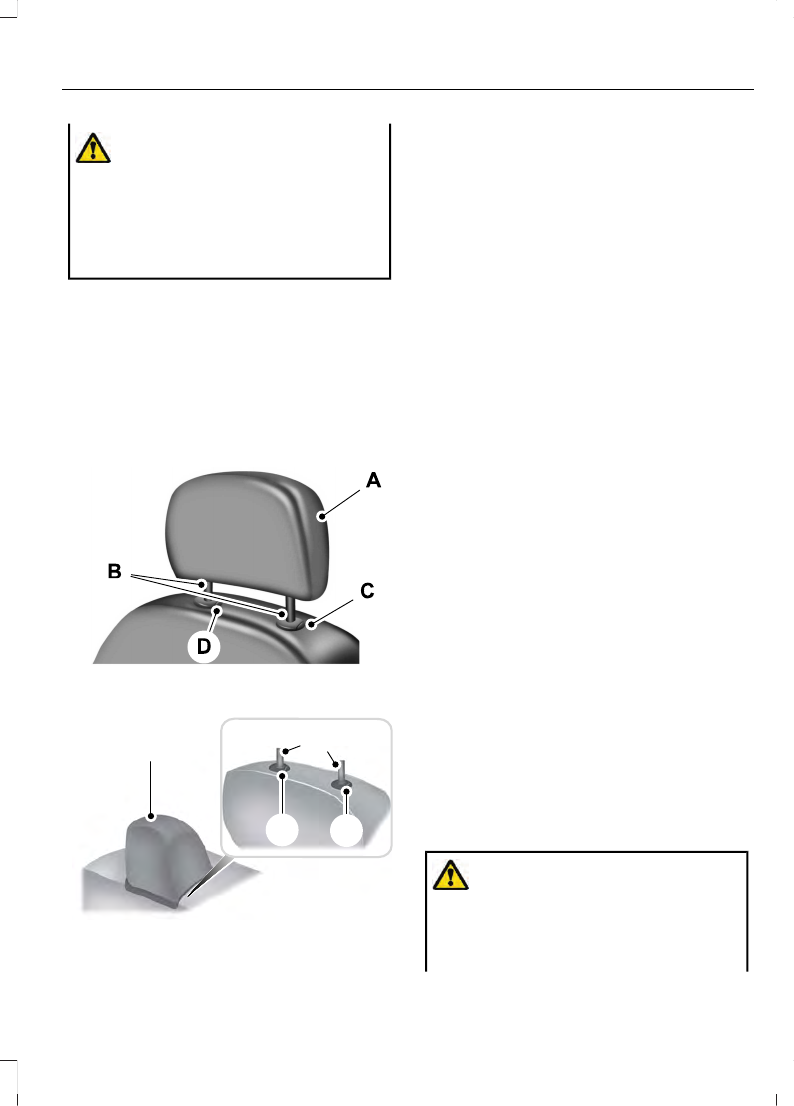
Head Restraint
E138642
Rear Seat Center Head Restraint
E166701
A
D
C
B
The head restraints consist of:
An energy absorbing head
restraint.
A
Two steel stems.
B
Guide sleeve adjust and release
button.
C
Guide sleeve unlock and remove
button (if equipped).
D
Adjusting the Head Restraint
Raising the Head Restraint
Pull the head restraint up.
Lowering the Head Restraint
1.
Press and hold button C.
2. Push the head restraint down.
Removing the Head Restraint
1.
Pull up the head restraint until it
reaches the highest adjustment
position.
2. Press and hold buttons C and D.
3. Pull up the head restraint.
Note:
For rear outermost seats, fold the
seat backrest forward for easier removal
(only double cab).
Installing the Head Restraint
Align the steel stems into the guide sleeves
and push the head restraint down until it
locks.
MANUAL SEATS
WARNING:
Do not adjust the driver
seat or seat backrest when your vehicle
is moving. This may result in sudden seat
movement, causing the loss of control
of your vehicle.
125
Seats
WARNING:
Make sure the seat fully
locks into place by rocking it backward
and forward.
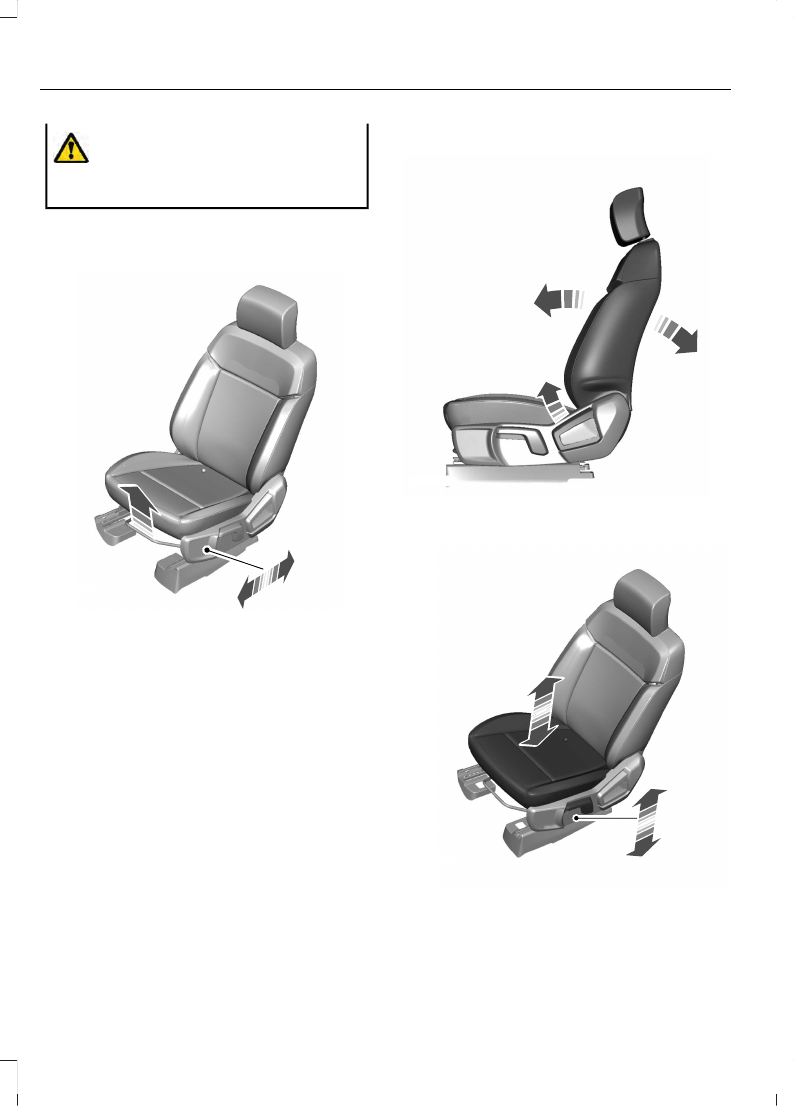
Moving the Seat Backward and
Forward
E331208
Adjusting the Recliner
E331209
Adjusting the Seat Height
E331210
126
Seats
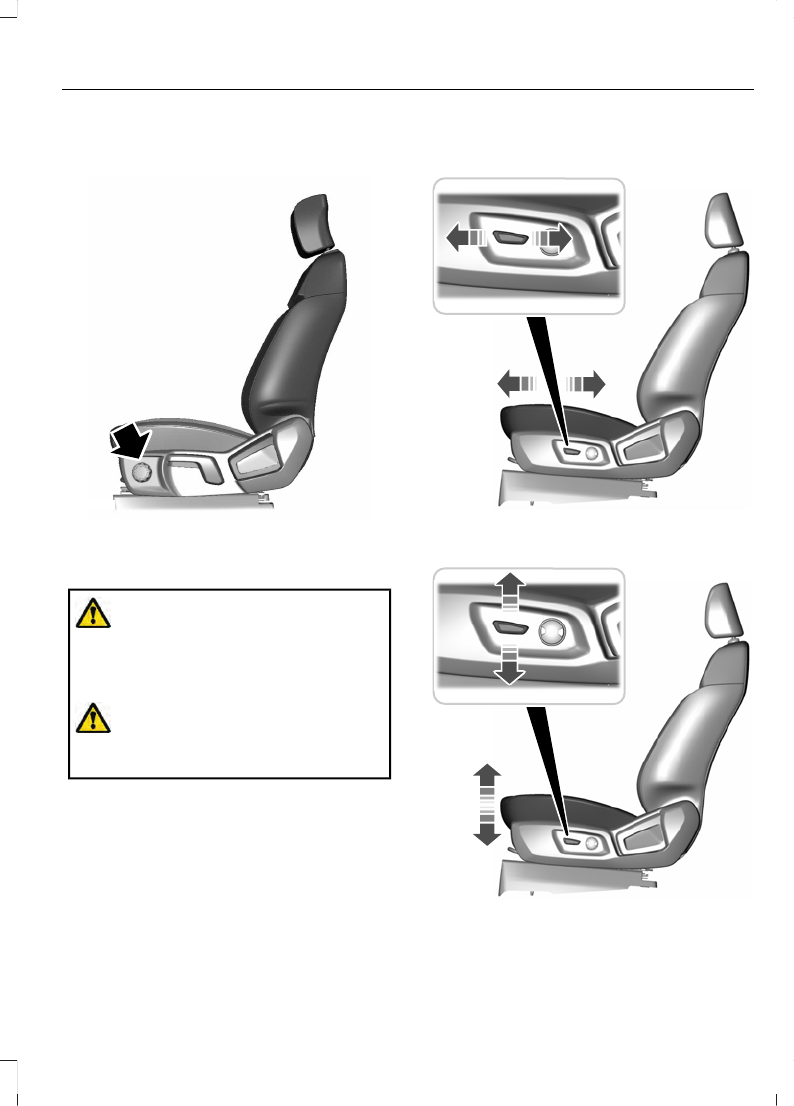
Adjusting the Lumbar Support
(If
Equipped)
E331529
POWER SEATS
(IF EQUIPPED)
WARNING:
Do not adjust the driver
seat or seat backrest when your vehicle
is moving. This may result in sudden seat
movement, causing the loss of control
of your vehicle.
WARNING:
Do not place cargo or
any objects behind the seatback before
returning it to the original position.
Moving the Seat Backward and
Forward
E274074
Adjusting the Driver Seat Height
E273890
127
Seats
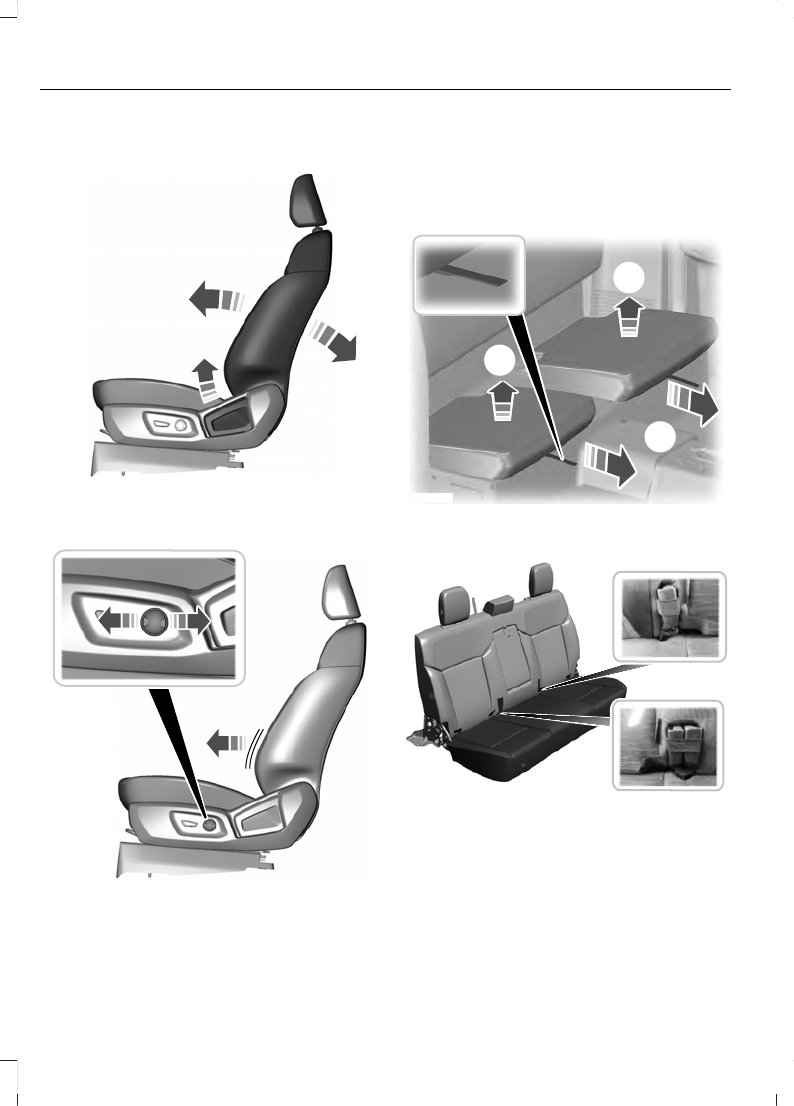
Adjusting the Recliner
E273885
Adjusting the Lumbar
E273887
REAR SEATS
(IF EQUIPPED)
Removing the Seat Cushion
Super Cab
2
2
1
E131743
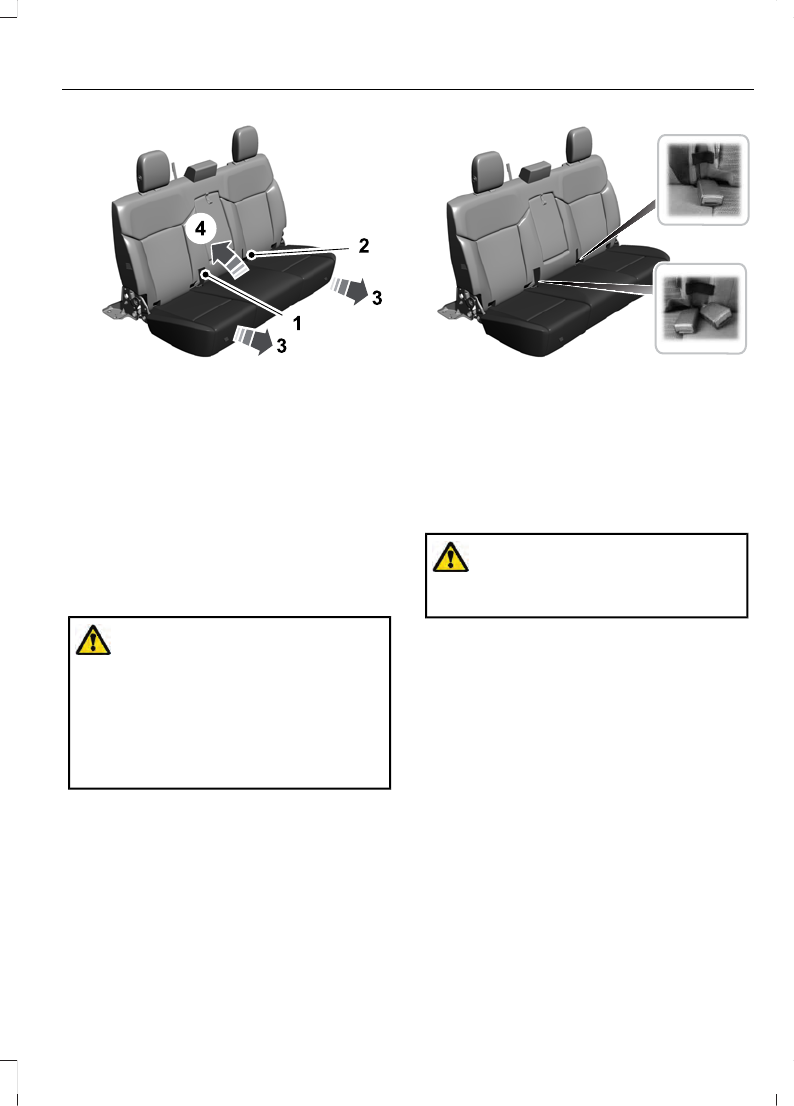
Folding the Seat Cushion
E275421
128
Seats
E275422
1.
Place the passenger side seat buckles
behind the elastic strap on the seat
backrest.
2. Place the driver side seat buckle behind
the elastic strap on the seat backrest.
3. Pull the tether straps.
4. Raise the seat cushion.
Note:
When folding the cushion up, make
sure that the seatbelt buckles are visible to
an occupant and are not under the seat.
Unfolding the Seat Cushion
WARNING:
Make sure that cargo
and other objects are not trapped under
the seat cushion and that you return the
seat cushion to the full-down position.
Failure to do so may prevent the seat
from operating properly, which could
increase the risk of serious injury in a
crash.
E275423
1.
Push the seat cushion down.
2. Remove the seatbelt buckles from
behind the elastic strap on the seat
backrest.
Note:
You must stow the cushion tether
strap in the pocket provided.
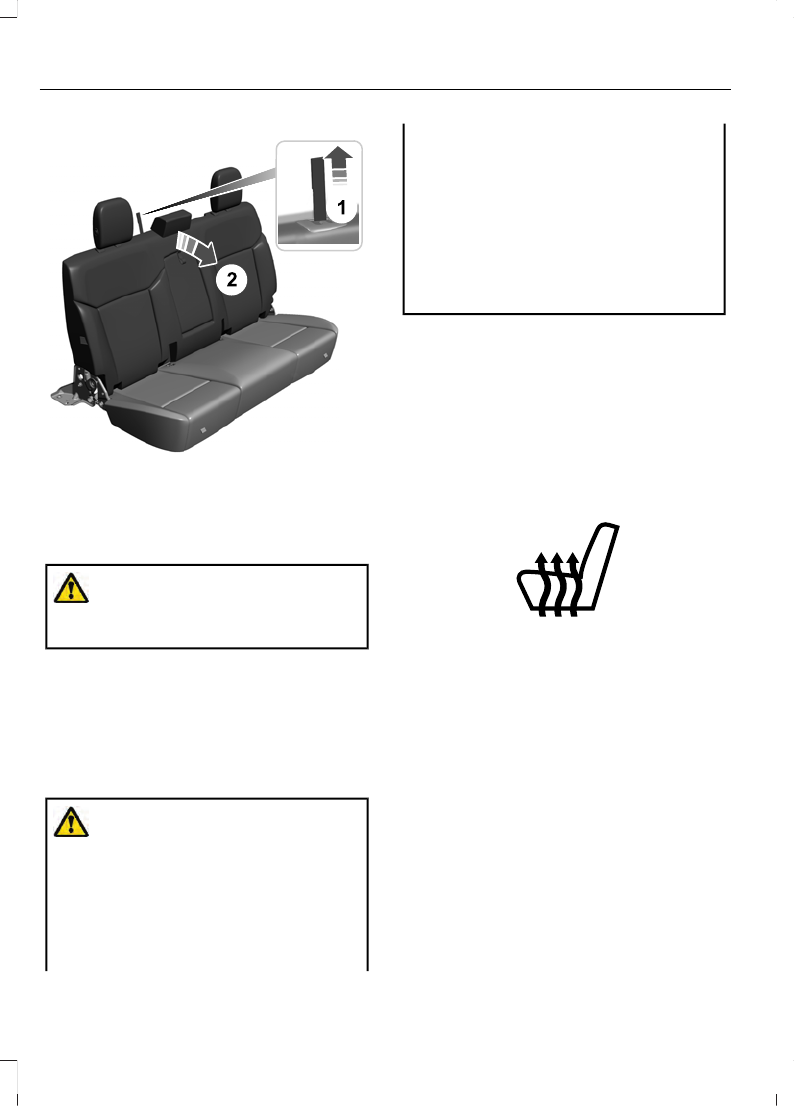
Folding the Seat Backrest
WARNING:
When folding the seat
backrest down, take care not to get your
fingers caught in the mechanism.
Note:
Do not use the rear surface of the rear
seat backrest as a load floor.
Note:
Do not unlatch and fold the seat
backrest when the seat cushion is folded
up.
129
Seats
E275420
1.
Pull the release strap up.
2. Push the seat backrest forward.
Unfolding the Seat Backrest
WARNING:
Make sure that the
seats and the seat backrests are secure
and fully locked in their catches.
Note:
When unfolding the seat backrest,
make sure that the seatbelts are visible to
an occupant and not caught behind the
seat.
HEATED SEATS
(IF EQUIPPED)
WARNING:
People who are unable
to feel pain to their skin because of
advanced age, chronic illness, diabetes,
spinal cord injury, medication, alcohol
use, exhaustion or other physical
conditions, must use caution when using
the heated seat. The heated seat may
cause burns even at low temperatures,
especially if used for long periods of time.
Do not place anything on the seat that
may block the heat, such as a blanket or
cushion. This can cause the heated seat
to overheat. Do not puncture the seat
with pins, needles or other pointed
objects. This damages the heating
element and can cause the heated seat
to overheat. An overheated seat may
cause serious personal injury.
Do not do the following:
•
Place heavy objects on the seat.
•
Operate the heated seat if water or any
other liquid spills on the seat. Allow the
seat to dry thoroughly.
•
Operate the heated seats unless the
engine is running. Doing so could drain
your vehicle battery.
E146322
Press the heated seat symbol to cycle
through the various heat settings and off.
More indicator lights indicate warmer
settings.
The heated seats only operate when you
switch the ignition on.
The maximum temperature is reached
after five or six minutes. It is regulated
thermostatically.
The heated seats remain on until you either
switch the heated seats off or you switch
the ignition off.
130
Seats


